

The Key Equipment That Turns Holding A Workpiece Into Consistent Manufacturing
In mechanical manufacturing, automotive components, engineering equipment and steel structure fabrication, welding is one of the most critical processes. During welding, the workpiece must hold an accurate position and a stable orientation; otherwise misalignment, deformation and uneven weld beads are likely to occur. Welding workpiece fixtures are tooling designed precisely to solve these problems. Through locating, clamping and supporting, they hold the workpiece to be welded in a predetermine dposition and provide stable, reliable working conditions for the welding operation. A fixture is usually not the most visible piece of equipment on a production line, yet it directly affects welding accuracy, cycle time and product consistency, which is why it is known as the invisible assistant of welding manufacturing.
What Is A Welding Workpiece Fixture?
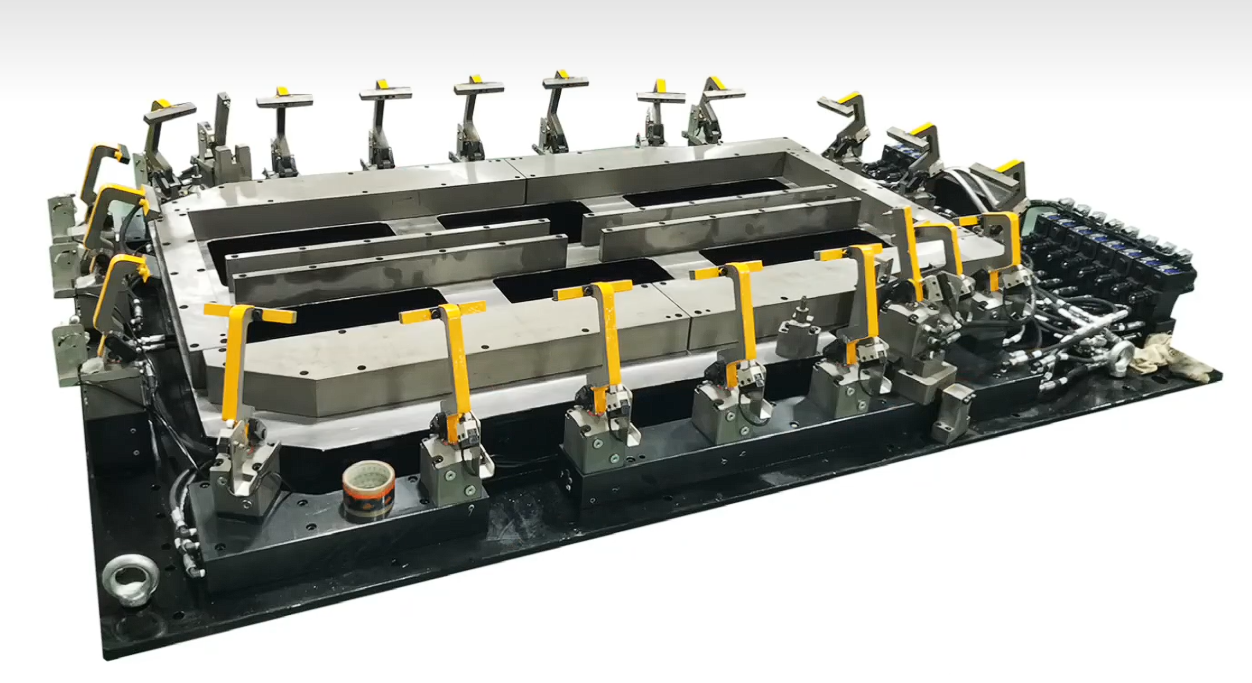
A welding workpiece fixture is a process tool used to hold and locate the workpiece during welding.It normally consists of locating elements, clamping mechanisms, support structures, a base plate and any necessary guiding or adjustment components.
In actual operation, a fixture performs three main tasks:
1. Accurate positioning: defines the mounting position of the workpiece and the relationship between parts, reducing assembly error.
2. Reliable clamping: prevents the workpiece from shifting, loosening or warping during welding.
3. Auxiliary support: provides support for thin plate, long components or workpieces with complex structures, reducing the risk of welding distortion.In simple terms, a fixture must not only hold the workpiece firmly; it must also position accurately, operate quickly and make welding convenient.
Common Types Of Welding Workpiece Fixtures
Fixed Fixture
A fixed fixture has a relatively stable structure and is normally mounted on a workbench or a dedicated base plate, making it suitable for production runs with few product models and large batch volumes. Its advantages are reliable positioning and good repeatability, while its flexibility is comparatively limited.
Adjustable Fixture
An adjustable fixture adapts to workpieces of different sizes and shapes by repositioning locating blocks, support pieces or clamping mechanisms. It suits multi-variety, small-batch production and reduces how often an entire fixture set has to be changed over.
Modular Fixture
A modular fixture consists of standardized modules, base plates, locating units and clamping units that can be recombined according to the workpiece structure. It offers strong versatility and makes model changeover and maintenance easier.
Pneumatic Or Hydraulic Fixture
This type of fixture uses cylinders or hydraulic elements to complete the clamping action. It features fast operation and relatively stable clamping force, making it suitable for production lines with tight cycle-time requirements. It requires a stable supporting power and control system in operation.
Tilting Fixture Or Welding Positioner
For workpieces that require welding from multiple angles, a tilting fixture or a welding positioner helps to change the workpiece orientation so that the weld seam is easier to reach, improving operator convenience and welding accessibility.
What Factors Should You Consider When Selecting A Fixture?
• Workpiece size and structure
• Welding process and operating space
• Whether the clamping force is appropriate
• Whether quick loading and unloading are supported
• Whether maintenance and adjustment are convenient
Post time: Oct-26-2026


