

II. Why It Is Needed: Reach Is the Most Honest Boundary
The space a six-axis industrial robot can touch is roughly a spherical shell centred on its base. In publicly available industry material, welding robots commonly have a reach in the 1.5–3 m range, which means a floor-mounted unit typically covers only two to three metres of effective width.
Once a workpiece exceeds that scale, there are only three options:
• Add robots — investment, floor space, programming and maintenance all multiply together;
• Add positioners that “turn the workpiece toward the robot” — suitable for small and medium parts, while long workpieces deflect under their own weight;
• Let the robot move — in other words, the seventh axis.
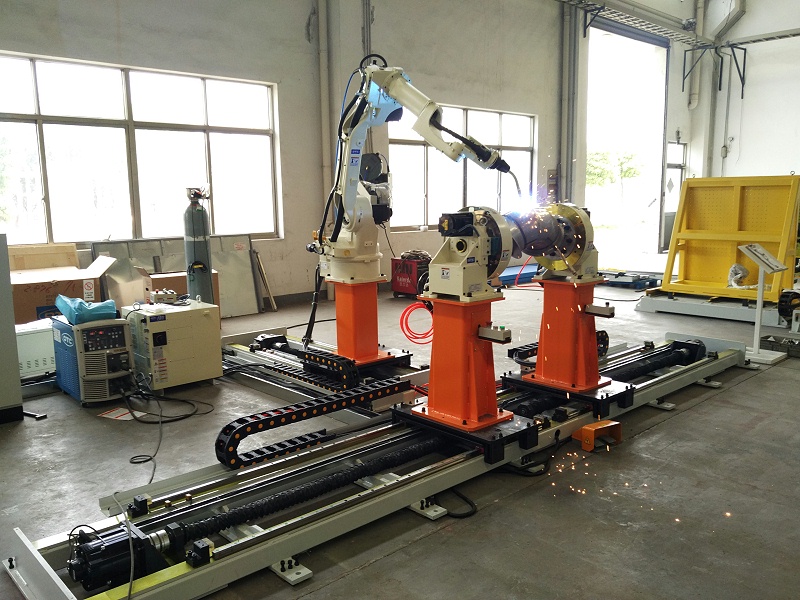
Manufacturer case studies show that, once a travel axis is added, the covered length of a single unit can stretch from “arm-reach scale” to well over ten metres, even tens of metres (public examples include long-stroke floor tracks at the 20 m and 50 m level). This does not make the robot stronger; it lets the robot spend its time where welding is actually needed.
III. The Key Is Not the “Track” but the “Seventh Axis”
Most engineers think of a floor track as a mechanical component, but the real threshold sits on the control side:
• It is the seventh axis inside the controller and is interpolated together with the six joint axes, supporting either a coordinated “travel while welding” path or a “move, settle, then weld” sequence.
• Origin calibration is mandatory: a stable coordinate relationship must be established between the mechanical origin of the track and the robot’s tool centre point (TCP); otherwise every weld segment will be offset as a whole.
• Soft limits and collision avoidance: when several robots share one track, or when a robot coexists with positioners and fixtures, zone interlocking is required.
• On accuracy, product data published by some manufacturers quote repeat positioning accuracy of the travel axis at the ±0.05 mm level. Note that this is a nominal value at the drive and guideway level. Actual weld accuracy is also affected by track straightness, foundation settlement, thermal deformation, fixture positioning and the robot’s own calibration. Do not rely on a single number — specify every item in the technical agreement.
Post time: Nov-12-2026


