

From “Workers Adjusting Their Positions” to “Equipment Adjusting the Workpiece Position”:
Welding Operations Gain a More Stable Process Solution
In structural steel, construction machinery, pressure vessel, automotive component, and various metal fabrication applications, welding quality depends not only on welder skill and welding parameters, but also on the position of the workpiece. When handling large, irregular, or multi-sided workpieces, welders often need to repeatedly adjust their body position or rely on lifting equipment to move the workpiece before completing welds in different directions.
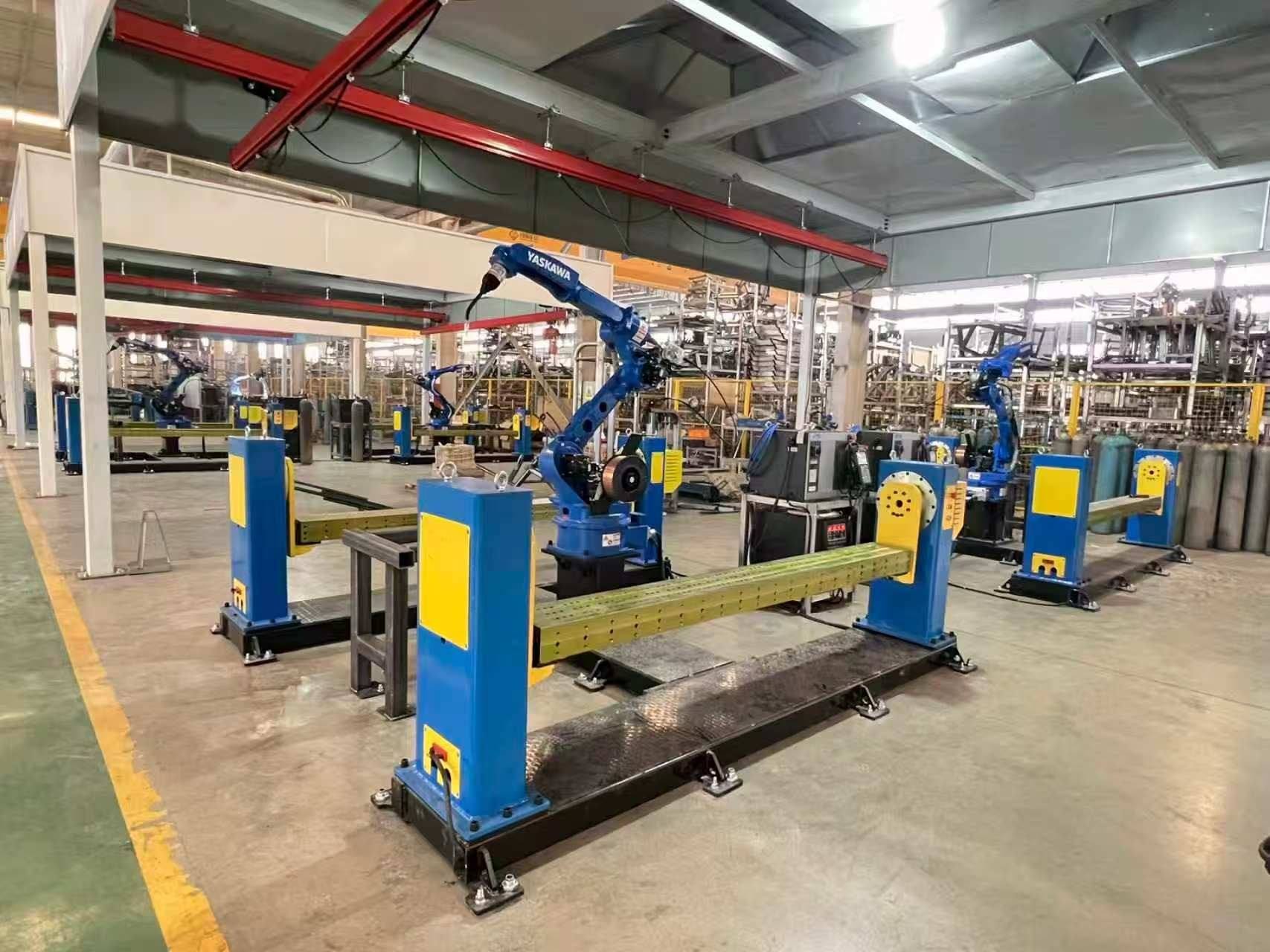
A welding positioner is auxiliary equipment designed to solve this problem. It supports the workpiece and uses rotation, turning, tilting, or lifting movements to bring the weld seam into a more suitable position for welding, making the process smoother and more stable. In simple terms, a welding positioner does not replace the welder and perform every task; instead, it helps welders and welding robots complete the work in a more reasonable position.
What Is a Welding Positioner?
A welding positioner typically consists of a frame, rotary mechanism, tilting mechanism, fixture or worktable, drive system, electrical control system, and safety protection devices. Depending on the structure and process requirements, common configurations include single-axis, dual-axis, three-axis, and multi-axis positioners, as well as roller-type, head-and-tailstock, L-type, U-type, and tilting designs.
Its core function is to position the workpiece and adjust its orientation. The equipment can rotate the workpiece at a preset speed or tilt it to a specified angle, thereby reducing the time that weld seams remain in unfavorable overhead or vertical positions. For workpieces requiring continuous or multi-side welding, a positioner can also shorten auxiliary handling time and improve workflow continuity.
Main Functions of a Welding Positioner
1. Improves the welding position of the weld seam
2. Reduces manual handling and repeated positioning
3. Improves the consistency of weld quality
4. Increases equipment and workshop utilization
5. Improves working conditions and safety
What Are the Typical Application Scenarios?
In the construction machinery industry, positioners are commonly used for welding booms, brackets, bases, frames, and box-type components. These workpieces are usually large, with weld seams distributed in multiple directions, and a positioner can reduce frequent lifting operations.Welding Positioner Popular Science Article In structural steel and metal fabrication, positioners can be used for welding flanges, pipe fittings, frames, cylindrical structures, and support components. For circumferential welds, fillet welds, and multi-side welds, the rotary function helps welders maintain a relatively stable welding position.
In the manufacture of pressure vessels, pipelines, and energy equipment, head-and-tailstock or roller-type positioners are commonly used to position and rotate cylinders, pipes, and large assemblies. For workpieces requiring high coaxiality or repeat positioning accuracy, matching the fixture with the control system is particularly important. In robotic welding workstations, the positioner is usually integrated with the robot, welding machine, tooling fixture, and safety fencing to form a complete automated cell. The robot controls the welding torch movement, while the positioner changes the workpiece orientation. Working together, they can cover more weld areas.
Post time: Oct-22-2026


