

Walk into any serious fabrication shop and you notice something odd. The welding robot is barely moving. The part is. That reversal — moving the workpiece instead of the torch — is the whole idea behind a welding positioner, and it is one of the least discussed, most consequential pieces of equipment in modern metalworking.
Gravity Is the Real Opponent
Every weld is a small pool of liquid metal that wants to fall. In the flat position — 1G for grooves, 1F for fillets — gravity presses that pool down into the joint, where it helps fusion. Rotate the same joint to vertical or overhead and gravity turns against the operator: the pool sags, penetration becomes uneven, spatter climbs, and the welder compensates by lowering current and slowing down. That trade-off is measurable. Out-of-position welding generally forces lower heat input and smaller passes, which means more passes for the same joint and more chances for lack of fusion or slag entrapment. A positioner removes the trade-off by rotating the joint back to flat before the arc ever starts.
What the Machine Actually Does
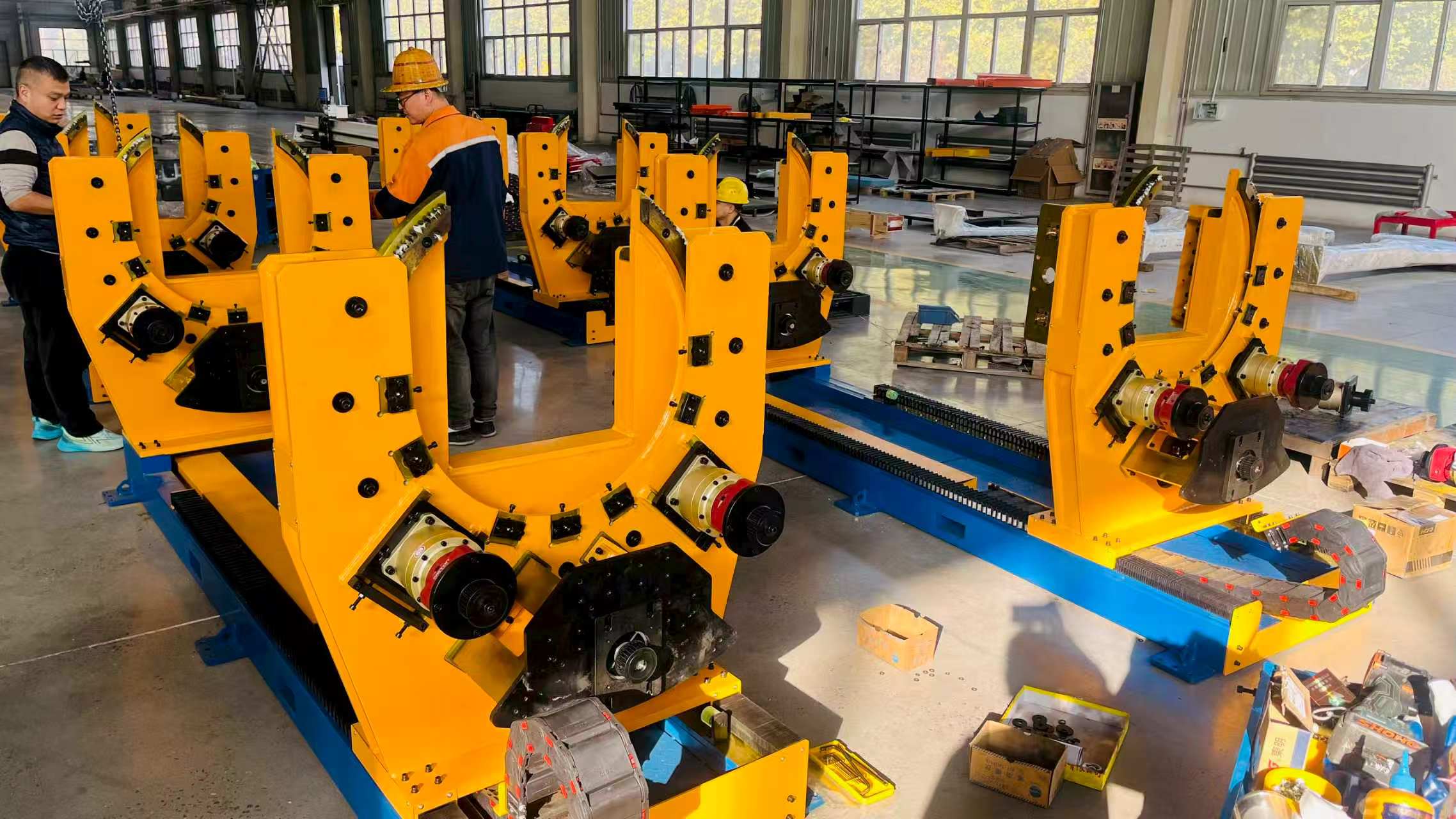
A welding positioner is a powered work-holding axis. It clamps the part on a table, chuck, or fixture and rotates and tilts it so the seam sits in the most favourable position — ideally flat, at a comfortable working height, and within reach of the torch. In a manual cell, the operator repositions between passes. In a robotic cell, the positioner becomes an external axis: the controller moves the robot and the workpiece together, so the torch keeps the correct angle and travel speed while the seam rotates underneath it. This is what makes circumferential welds on tanks, flanges and pipes repeatable instead of dependent on operator feel.
The Main Families
• Turntable (rotary table). One horizontal axis with continuous 360° rotation. The workhorse for circular seams, discs and flanges.
• Headstock–tailstock. Two opposed supports hold a long or asymmetric part at both ends. Common for shafts, beams and pressure-vessel sections where overhang would otherwise deflect.
• L-type (two-axis). Rotation plus tilt on a compact frame. Widely used in robot cells because it presents the part to the robot efficiently.
• H-type (two-axis, two stations). Rotation plus a 180° flip between two work positions, so the operator loads one side while the robot welds the other. This is the standard answer to "the robot is waiting for the operator."
• Three-axis / elevating. Adds lift or a third rotation, letting the machine place a heavy part at a workable height instead of forcing the welder to bend or climb.
Post time: Nov-05-2026


