

In the past, switching a welding robot to a new workpiece often meant half a day to a full day of downtime, with a skilled operator holding the teach pendant and guiding the torch point by point by hand. Today, with 3D vision, point-cloud reconstruction and automatic path planning now mature, a growing number of welding workstations can see for themselves, calculate for themselves and weld for themselves — what the industry calls “teaching-free.” What exactly does it remove, and what does it cost?
1. First, What Is “Teaching” Actually Teaching?
A welding robot does not “recognize” a workpiece. It only knows coordinates: the program tells it that the torch must travel from point A to point B, how fast to move, how wide to weave, and how much current and voltage to apply. The traditional method is online teaching. An operator drives the robot with the teach pendant, moves the torch in turn to the start point, the intermediate points and the end point of every weld, records each position one by one, and then test-welds repeatedly while fine-tuning the parameters. For a weld with a complex geometry, dozens of taught points are normal; for a workpiece with many welds, several hours of teaching is not unusual.
This approach is extremely efficient on high-volume, single-model production lines: teach it once and it runs for a year. But as soon as it meets the reality of “many models, small batches,” the problem is exposed. Order changeovers are frequent, teaching time can exceed the actual welding time, and the robot becomes the bottleneck instead of the solution. The more practical difficulty is that commissioning technicians who can teach skillfully are becoming increasingly scarce.
2. Teaching-Free: Trading “Teach the Position” for “Give It the Algorithm”
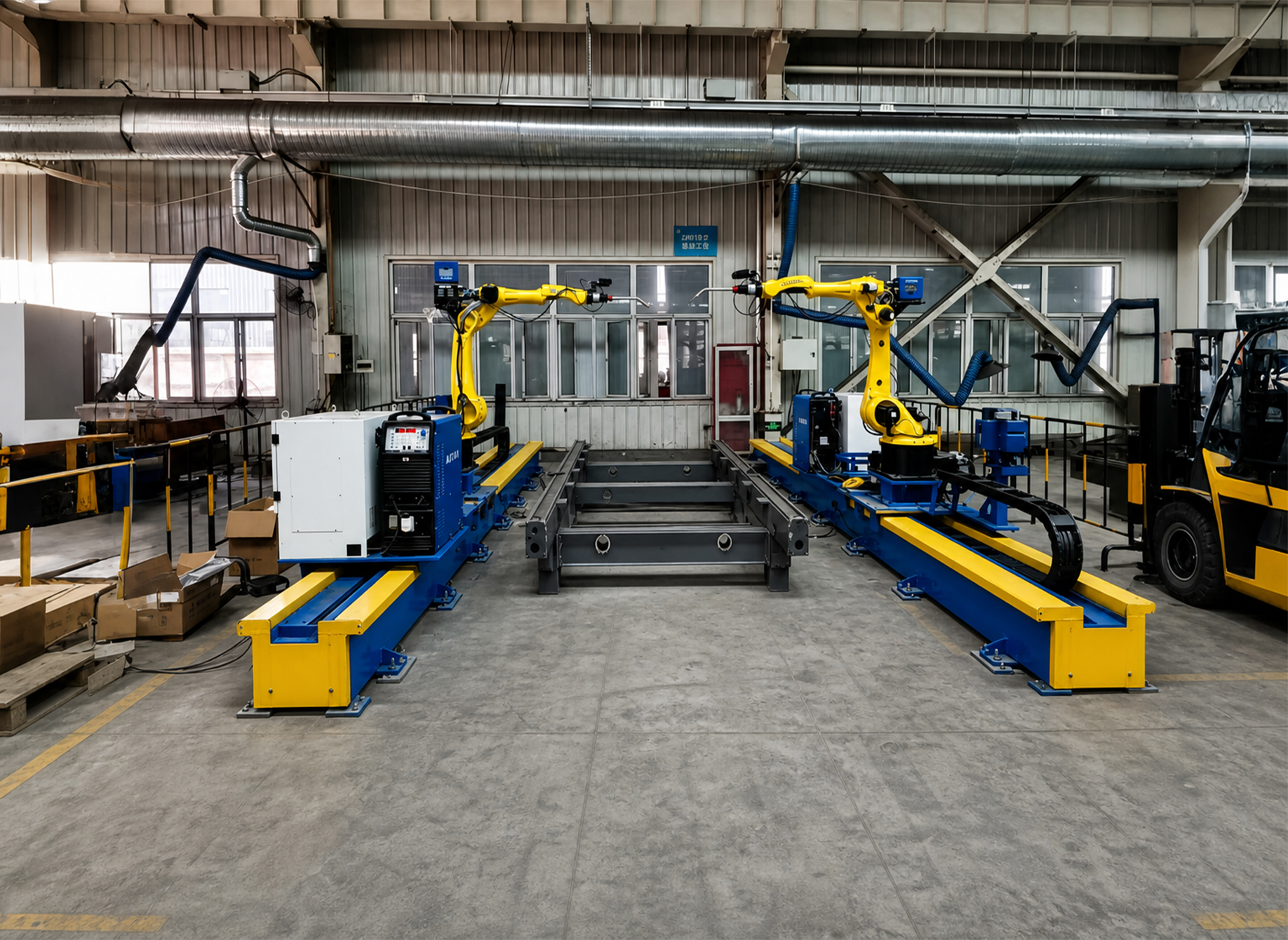
Teaching-free does not mean the robot needs no programming at all. It means that the job of telling the robot where the weld is has been handed over to the system itself. A typical teaching-free welding system is built from roughly four layers: Perception layer. A line-laser (structured-light) sensor or a 3D camera is mounted near the torch and projects laser stripes onto the workpiece; through the principle of triangulation it acquires the three-dimensional coordinates of the weld profile. This is the “eyes” of the entire system. Reconstruction and recognition layer. The sensor sweeps across the workpiece surface and returns a dense point cloud. The algorithm searches that cloud for typical geometric features — fillet joints, butt joints, lap joints, grooves — and identifies where the weld is, what type it is, how deep. This step sets the floor of the system: if the weld is misidentified, everything downstreamis wrong.
Planning and decision layer. Based on the recognized three-dimensional run of the weld, the robot’s motion trajectory is generated automatically, together with posture optimization and collision checking so that the torch does not strike the workpiece or the fixtures; then, according to plate thickness, joint type and material, current, voltage, welding speed and weaving parameters are matched from the process library. Execution and feedback layer. During welding, the sensor keeps tracking the actual weld position and corrects deviation in real time; some systems also monitor the molten pool or the arc signal and apply dynamic compensation to the parameters. This layer turns “open-loop copying” into “closed loop correction.”
3. What It Really Changes Is Not Headcount, but Changeover
Much promotional material sums up the value of teaching-free as “saving one commissioning technician.” That underestimates it. What it truly moves is the flexibility of production organization. When changeover preparation is compressed from hours to minutes, “small batch, many models” stops being a forbidden zone for automated welding. Structural parts in construction machinery, beam-to-column nodes in the steel structure industry, mixed-model lines for auto parts, multi-specification orders for metal furniture scenarios once dismissed as “not enough volume to be worth a robot” start to make economic sense. The second change is consistency. Manual teaching depends on individual experience; the trajectories and parameters produced on different shifts by different technicians are never exactly the same. A teaching-free system calls the same recognition algorithm and the same process library, so parameter consistency is easier to guarantee and easier to trace. The third change is in what it asks of people. The role moves from a skilled welder who can position the torch and read the molten pool toward an equipment engineer who can calibrate the cell, maintain the sensors and review process parameters. This is not a simple substitution; it is a migration of skill structure.
Post time: Nov-10-2026


